
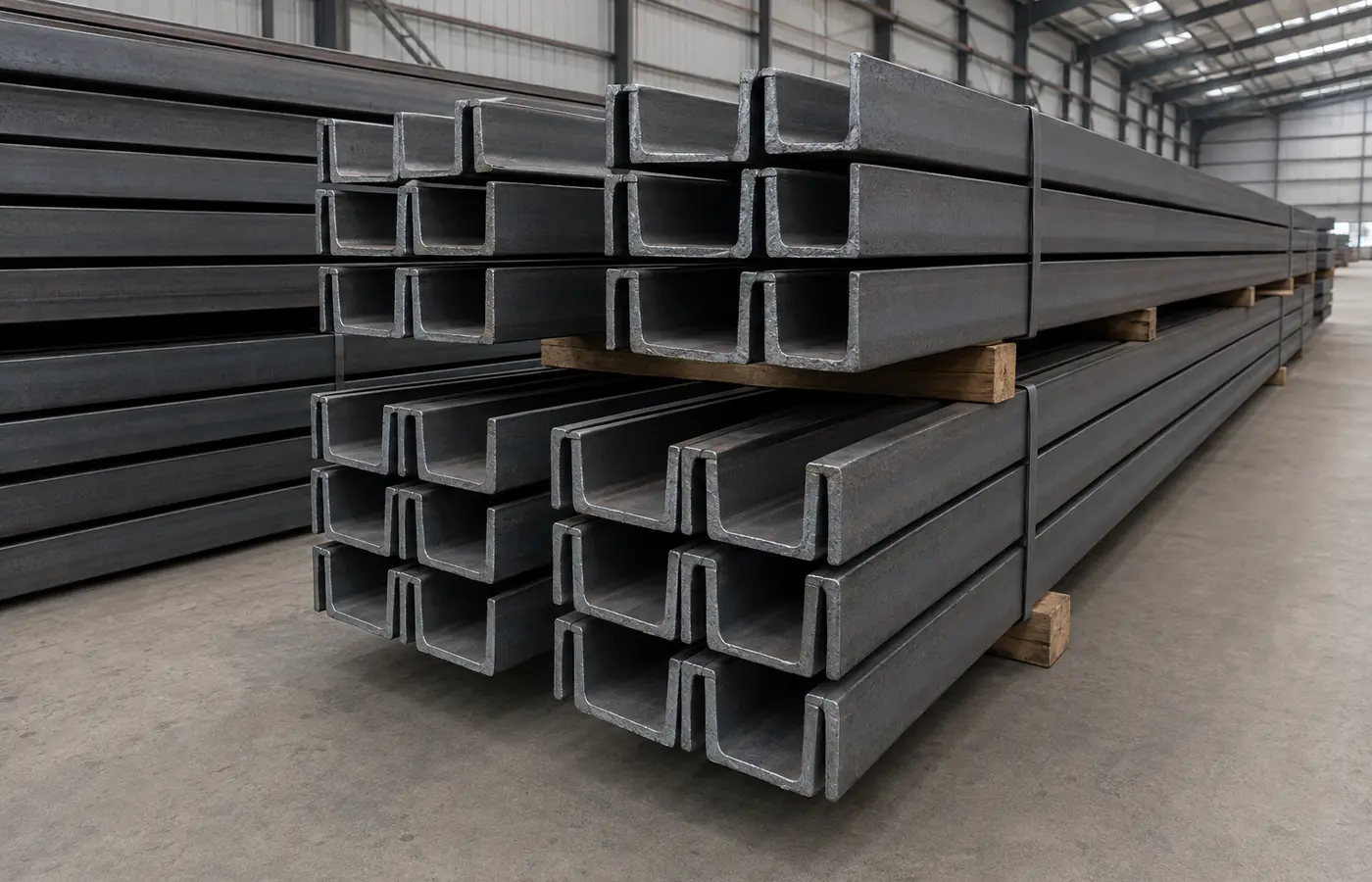
Specify more than channel depth
State the UPN series and size, grade, length, quantity, cut tolerance, finish and documentation. Similar overall depths can have different flange, web, radius, mass and section properties.
Use current producer tables to verify geometry and mass. Section selection and connection design remain the responsibility of the qualified project engineer.
Show the open-face direction
Mark whether the channel opens left, right, inward or outward, together with the reference end. Handed parts need separate identifiers.
Check tool access, cladding interfaces and drainage. Do not leave outdoor channels as water-catching pockets without a designed detail.
Follow the real load path
A channel is not doubly symmetric. Loading away from the intended axis can produce twist as well as bending.
The design must show load introduction, lateral restraint and support against rotation. Back-to-back channels or tie plates require engineering, not assumption.
Check connections at full scale
Verify edge distances, hole spacing, root radii, flange slope, washer bearing and wrench clearance against the actual section.
Do not flame-enlarge holes, force bolts or fill misalignment with weld. Stop and obtain an approved correction when parts do not fit.
Control cutting and welding distortion
Mark length, mitre and reference end before cutting, support the section and approve the first part before batch production.
Follow the approved welding sequence and procedure. Uncontrolled heating or forceful straightening requires technical approval.
Plan lifting and temporary stability
Open channels may rotate while suspended. Use a job-specific lift plan, suitable lifting points and edge protection; packaging bands are not lifting gear.
Temporary bracing and the release-from-crane condition must be defined before erection. One bolt or tack is not proof of stability.
Keep an auditable record
At receipt verify labels, section, grade, length, quantity, documents, straightness and damage before cutting or coating.
Record part identity, orientation, hole positions, welding, bolt checks, coating repair and final location through completion.