
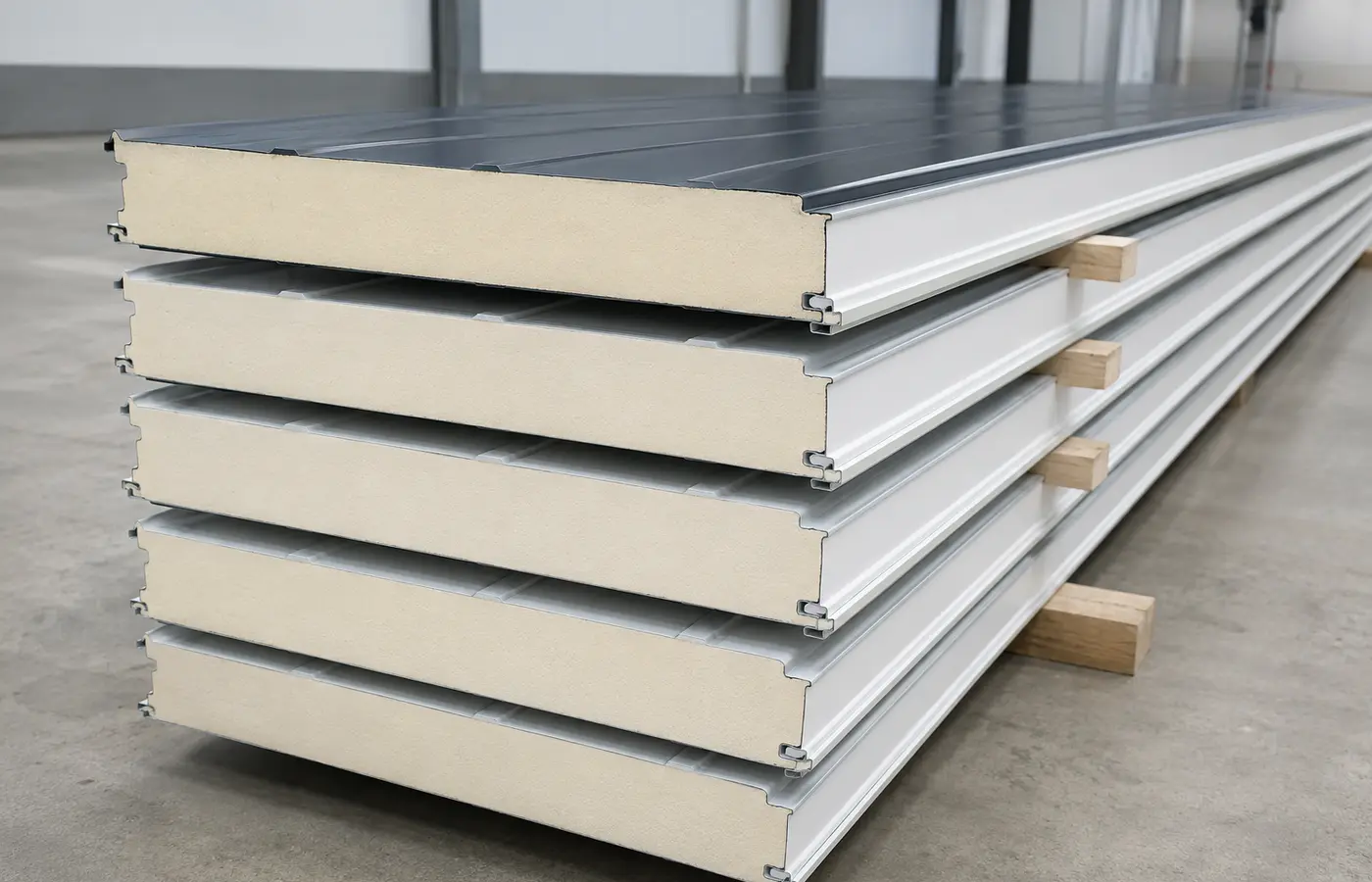
Plan before the truck arrives
Confirm access, ground conditions, unloading order, equipment capacity, pack dimensions and the route to storage before delivery.
Keep the current instructions for the exact panel and pack on site. Length, geometry and core type can change the approved lifting method.
Record labels and visible damage
Match every pack label to the order and erection plan. Check type, thickness, colour, length, quantity and pack number.
Photograph torn wrapping, wetness, shifted packs, crushed edges, scratches or joint damage before acceptance and quarantine doubtful material.
Lift from approved points
Packaging bands are not lifting gear. Use the specified fork spacing, slings, spreader beam and edge protection for the pack.
Trial-lift low, keep people outside the suspended-load zone and never drag single panels or use their joints as handles.
Choose firm, drained storage
Store packs on a firm, secure area using supports in the number and positions required by the manufacturer.
Maintain the specified slight slope for drainage and follow product rules for stacking, support alignment and storage duration.
Control rain and condensation
Provide weather protection without sealing the pack so tightly that ventilation is lost. Keep covers secure and drainage paths open.
If water enters, open the pack safely, separate and dry panels under supplier guidance, assess damage and document the action.
Treat protective film as temporary
Verify when film must be removed and whether it must come off before a particular lifting device is used. Sun and heat can make delayed removal difficult.
Do not grind over the film. Remove swarf promptly and use only manufacturer-approved cleaning methods for residues.
Release panels in erection order
Arrange packs by elevation, grid and panel sequence to reduce repeated handling. Reprotect the unused part of an opened pack.
Inspect colour, orientation, surface, edges, seals and joint geometry before installation, and record pack identity, storage and any technical disposition.