
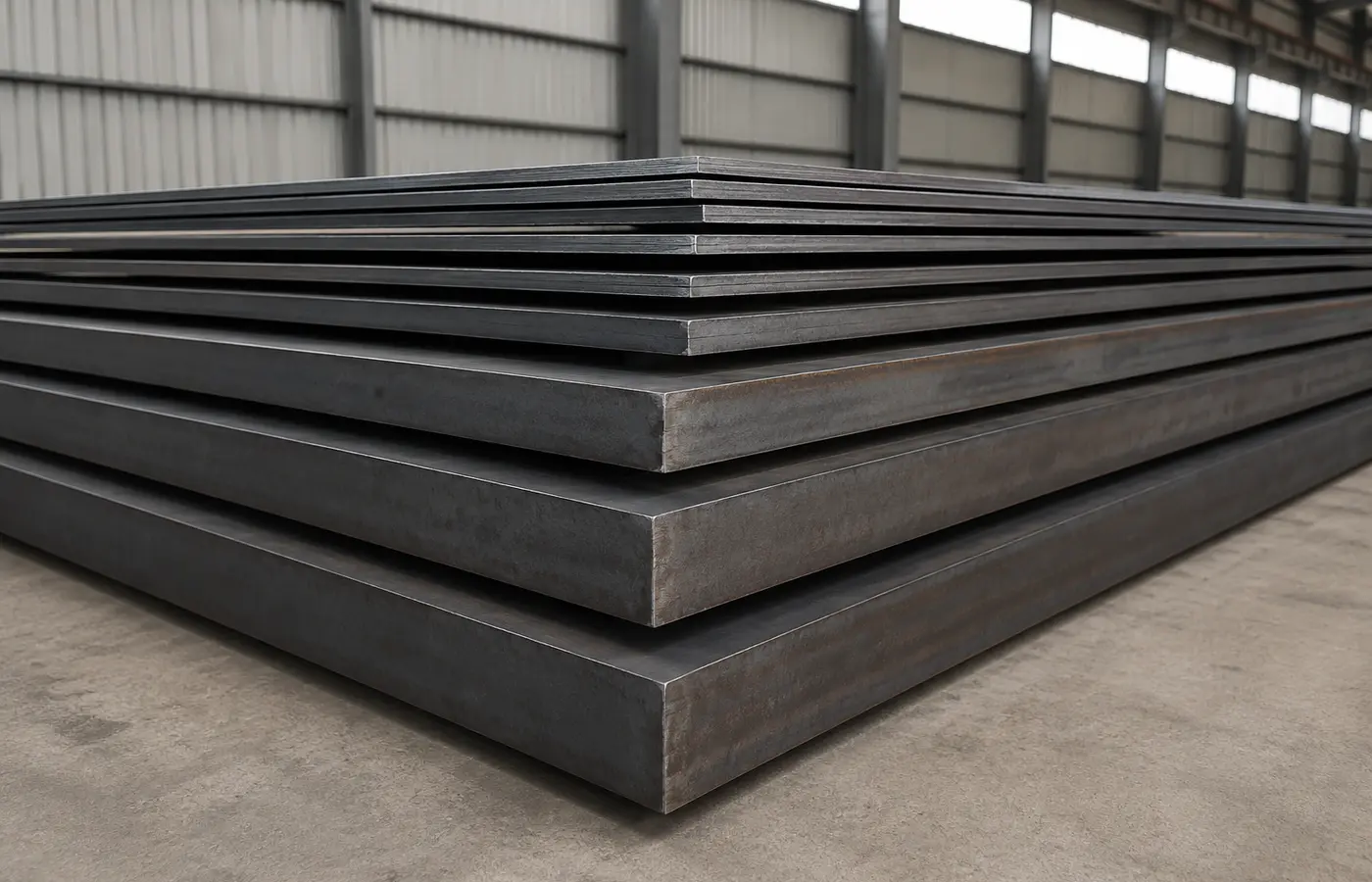
Define more than total area
List grade, nominal thickness, sheet width and length, quantity, surface condition, cutting and delivery format for every item. Equal area does not mean equal product or mass.
Build the finished-part list first, then nest those parts on actual stock sheets. Record holes, bends, rolling direction, visible face and finishing before cutting.
Calculate theoretical mass consistently
Mass equals width × length × thickness × density. SSAB gives 7,850 kg/m³ for a typical hot-rolled structural steel, while BlueScope publishes the same volume-times-density method for plate.
A 1 × 2 × 0.005 m sheet is theoretically 78.5 kg at that density. Treat this as a planning value, not a certified scale weight.
Separate nominal and measured dimensions
Nominal gauge does not mean every point is mathematically exact. Product standards define permissible thickness, width, length and flatness variation.
State tighter requirements before ordering and use an appropriate sampling and measuring method. Keep measured values separate from nominal calculation inputs.
Build a production-ready cutting list
Give every part a unique code with quantity, finished size, material, tolerance, reference face and next operation. Mark handed parts and rolling direction where relevant.
Allow for kerf, edge trimming, heat-affected areas, gripping and deburring. Confirm the first part before releasing the complete batch.
Calculate scrap from the layout
Scrap includes edge trim, spacing, kerf, samples, defective areas and remnants too small for controlled reuse. One fixed percentage cannot describe every job.
Label reusable remnants with material, grade, thickness and dimensions. Record process errors separately from normal geometric scrap.
Connect package mass to lifting
Add packaging and separators to the theoretical sheet mass and assess centre of gravity, flexibility, sharp edges and lifting points.
Verify actual package weight and equipment limits. Do not lift from packaging bands or place anyone beneath a suspended load.
Plan delivery and storage
Check vehicle access, unloading direction, fork spacing, crane reach and rack suitability before ordering large sheets.
Store sheets flat, elevated, supported evenly and protected from water with ventilation. Separate and label grades and thicknesses.
Close with a verified order table
Show part code, grade, thickness, stock size, sheet count, unit and total theoretical mass, scrap, cutting method and delivery package in one table.
At receipt, match labels and independently check counts, dimensions, surface and weight where available. Reconcile units, packaging and tolerances before alleging a shortage.