
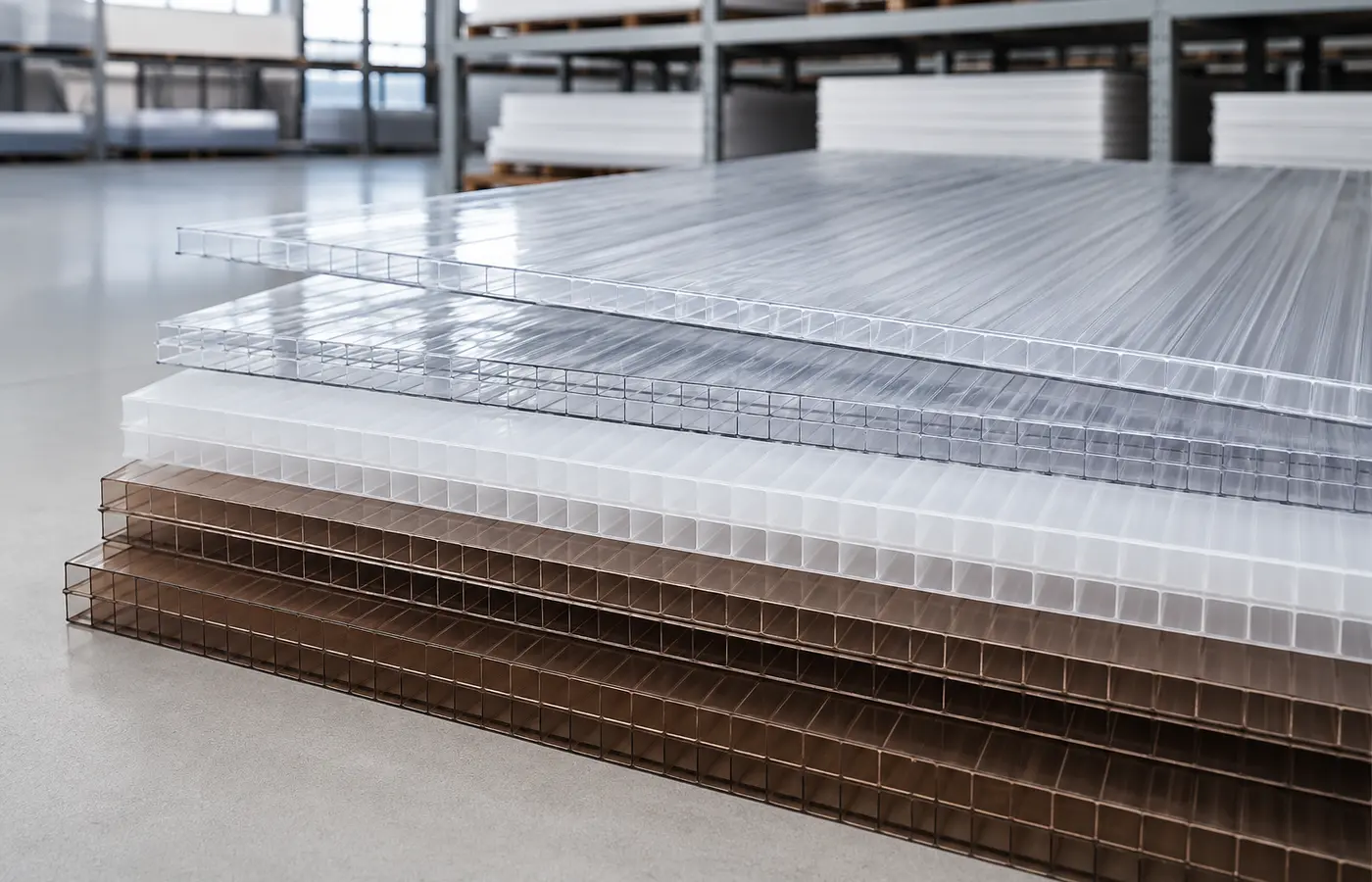
Identify the sheet and protected face
Solid, multiwall and profiled polycarbonate require different cutting, drilling and edge details. Confirm the product label, UV face, channel direction and current manufacturer guide.
Include glazing-channel engagement, thermal movement, laps and edge closures in the finished dimensions; mark every part's orientation before cutting.
Prepare the cutting plan
Mark from a verified reference edge, check diagonals and number repeated pieces on the protective film.
Keep film in place where allowed, but do not let it fold into the blade or remain outdoors beyond the manufacturer's stated period. Prove the kerf and guide offset on a sample.
Support the whole sheet
SABIC advises clamping LEXAN Thermoclear to a support table to prevent vibration and rough cuts. Support both sides so the offcut cannot break away under its own weight.
Spread clamp pressure with clean blocks and organise cables, extraction and helpers before handling large sheets.
Match blade and feed to the product
Use the sharp blade geometry, tooth count, speed and feed specified for the sheet. A dull blade heats and pushes the polymer; excessive or insufficient feed can chip or melt the edge.
Keep the saw base stable and avoid unapproved hot methods, grinders or lasers unless the exact product guide permits them.
Plan holes away from edges
Coordinate holes with the glazing profile, gasket and support. Avoid sharp internal corners; start a cut-out with the specified radius hole where the detail requires it.
Use a sharp plastic-suitable drill, support the exit face, disable hammer action and reduce pressure as the bit breaks through.
Allow thermal movement
Exterior holes must allow the sheet to move relative to its support. Determine clearance from the sheet length, temperature range and current product table rather than a universal rule.
Use compatible washers and elastomer seals; tighten squarely without dishing the sheet or crushing the gasket.
Remove swarf and close channels
Remove burrs and chips with approved non-scratching methods; never flame-polish or apply a solvent without confirmation.
Clean multiwall channels, then fit the specified upper and lower tapes and closure profiles without blocking designed drainage or ventilation.
Approve the first piece
Dry-fit the first part and verify clearance, squareness, channel direction, UV face and hole alignment before batch cutting.
Record the sheet code, blade, bit, dimensions, hole layout and closure system; reject cracks, whitening, melted edges, crushed channels or stressed fixings.