
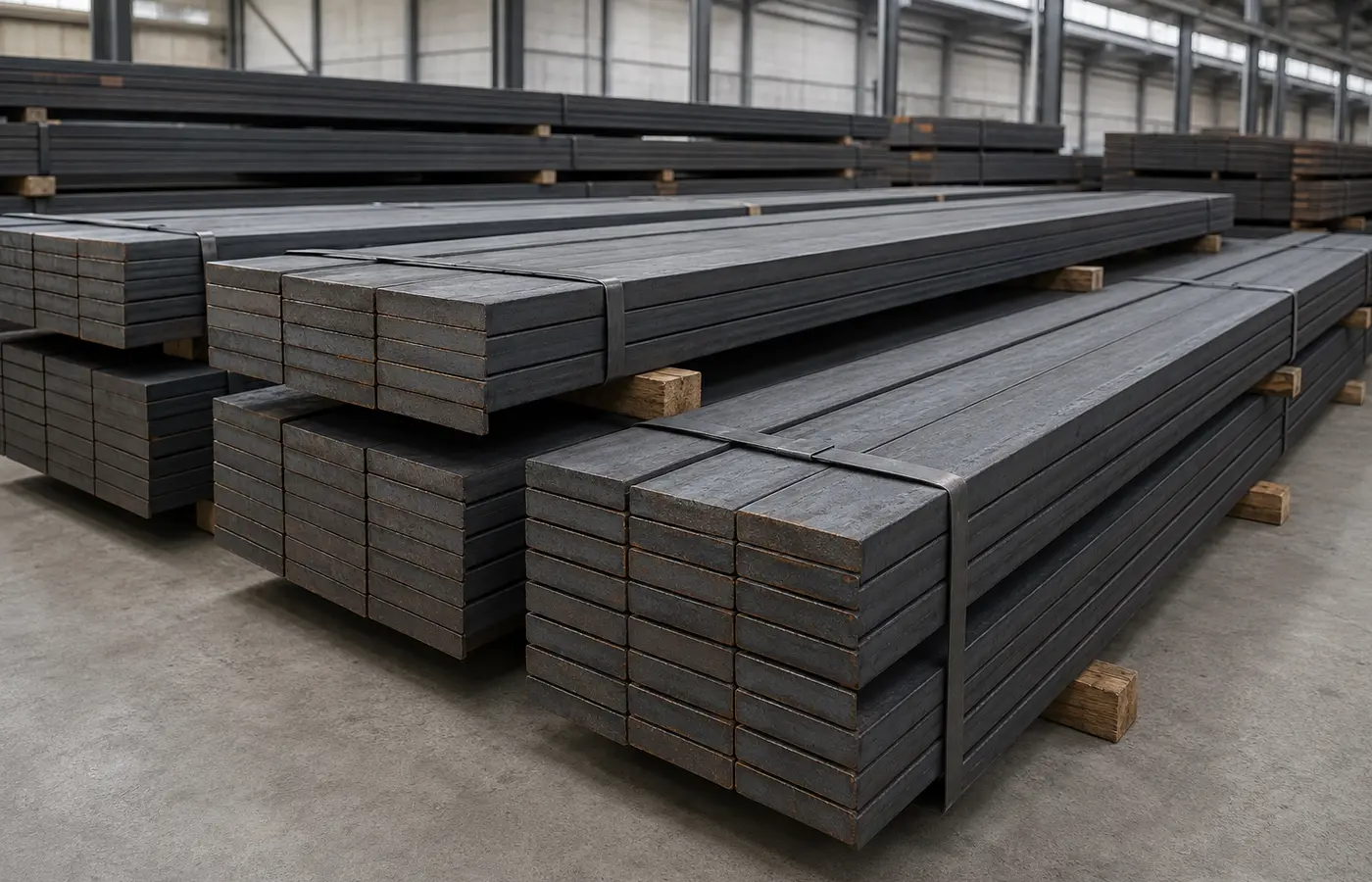
Specify flat bar by duty, not appearance alone
Steel flat bar is a solid product with a rectangular cross-section. Its broad face is convenient for marking, cutting, drilling, welding and fastening, which explains its use in everything from brackets and machine feet to gates and workshop frames.
Trade terms such as flat bar, strip and cut plate do not always describe the same manufacturing route, edge condition, grade or tolerance. A hot-rolled flat bar, slit strip and plate-cut component may look similar but differ in straightness, surface and edge quality. State width, thickness, length, grade, standard, finish and application rather than relying on a name alone.
Typical applications
One section can be processed into many useful parts, but the same size is not suitable for every duty.
- Rails and frame members in gates, fencing and metalwork
- Brackets, supports and machine-base details
- Drilled connecting strips and fastening parts
- Welded reinforcement, spacers and edge closures
- Decorative frames and visible linear details
- Project-specific clamps, hangers and small brackets
Select width and thickness for the load direction
Turning the broad face or narrow edge toward the bending direction changes stiffness substantially. Hole size and edge distance, weld length, span, impact and vibration also affect the required section.
For structural connections, platforms, guardrails, brackets or anything carrying people or overhead loads, selection by habit is unsafe. The engineer must verify section, grade, holes and welds. Flat bar used as a lifting device, lever or anchor likewise needs purpose-specific design and verified material.
Grade, dimensions and tolerances belong together
Width and thickness define geometry, not yield strength, tensile properties, weldability or delivery condition. ISO 1035:2026 addresses dimensions, shape, masses and tolerances for hot-rolled steel bars, while ISO 630-1 sets general delivery requirements for structural steels. The applicable product standard and national rules must be confirmed for the project.
Straightness, twist, edge shape, surface defects, burrs and cutting tolerances matter differently for a visible part, a production jig and a rough support. If certification is required, agree the grade, heat traceability and document type before ordering.
Plan cutting, drilling, bending and welding together
A useful part list shows finished length, cutting allowance, hole centres, bend direction, weld preparation and deburring. Holes near bends need checking for distortion and cracking according to grade and orientation.
Weldability depends on grade, carbon equivalent, thickness, hydrogen control, preheat and heat input—not on the flat shape. Safety-critical work requires an approved welding procedure and competent personnel. Tack sequence, fixtures and cooling should manage distortion instead of forcing a warped part into place.
Design coating details for coastal exposure
Bare carbon steel can corrode under moisture, salt and trapped water. In coastal areas, overlaps, holes, weld roots, cut ends and water pockets are often more vulnerable than the open face.
Select paint, galvanizing or another system for the environment and maintenance plan. Surface preparation, primer and topcoat must be compatible; holes or welds made after coating need approved repair. Dissimilar-metal contact and drainage also require attention.
Information for a useful quotation
Send the application and drawing together with:
- Width, thickness, length, quantity and tolerances
- Steel grade, product standard and certificate
- Cutting, holes, countersinking, bending, welding and deburring
- Visible-surface expectations
- Indoor, outdoor, coastal, wet or chemical exposure
- Primer, paint, galvanizing or uncoated delivery
- Packing, labelling, transport and unloading requirements